Contact us at WeBuyRareBooks@gmail.com or Text Photos (646) 469-1851 for a free evaluation of your old and rare books. Our main gallery is located by appt. at 1050 2nd Ave (@55th) Gallery 90 in the Manhattan Art and Antique Center. We also have NEW California location at 6009 Paseo Delicias Suite A2 in Rancho Santa Fe (“The Rare Books Gallery”). We travel widely and buy nationwide.
In this video, I will show you how I value an early 17th century copy of the famous Malleus Maleficarum or the “Hammer of Witches” I’ll mention a couple sites that dealers use to check the completeness of rare books and look up auction prices which can help provide comparable for rare book appraisals. Feel free to reach out if you would like me to value any of your rare books or manuscripts. You can text photos directly to 6464691851 or email them to webuyrarebooks@gmail.com.
While this blog is primarily devoted to evaluations and appraisals of rare books, I made this video below with tips on some places where one can go today to hunt for and find rare books to buy. If you are a new collector, or want to get into the antiquarian rare book business, take a look.
I adore antiphonals. They are often massive volumes of calf over boards, with metal bosses, with the music and chants handwritten on vellum. Although they are becoming less and less common in commerce – they are surprisingly inexpensive compared with other medieval and renaissance manuscripts when they do pop up at auction.
Many were purchased by tourists in Spain- especially post WWII and brought back to the Sates as objects of great curiosity. I had a couple enquiries recently regarding some that were inherited in separate families – and understandably the sellers thought they could be worth small fortune (some are if illuminated or have important provenance, or are especially early). I made the video below to showcase one in the gallery here and what it is worth as an example.
If you have one, reach out and I am always happy to evaluate you manuscript.
Nothing more fun than getting excited about a new rare book acquisition! I’m testing youtube to highlight some fund purchases so the video is a little double-split tongue in cheek.
So, I’m just back from a trip up to Westchester, NY where I bought several boxes of antiquarian volumes that belonged to a prominent lawyer.
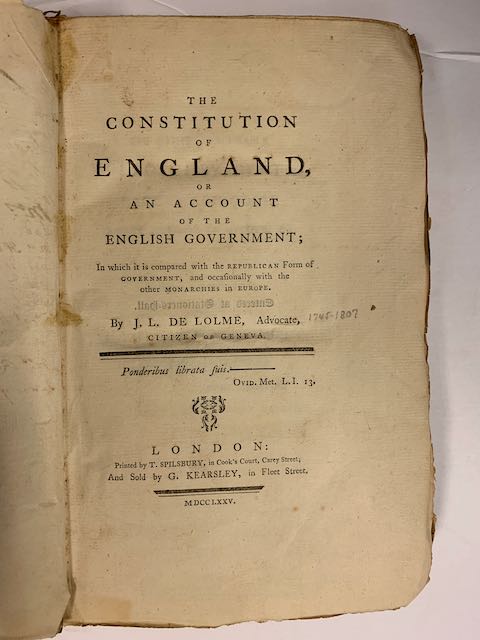
One of the volumes fresh out of the box is a copy of Jean Louis de Lolme’s The Constitution of England, or an Account of the English Government; In Which It Is Compared with the Republican Form of Government, and Occasionally with the Other Monarchies in Europe. Printed in London by T. Spilsbury and Sold by G. Kearsley, in 1775.
I love Constitutional law, especially anything printed around that magical year of the American Declaration. This volume was a frequently reprinted (I have had several copies over the years), but it still is an important work that influenced many of the framers of the United States Constitution.
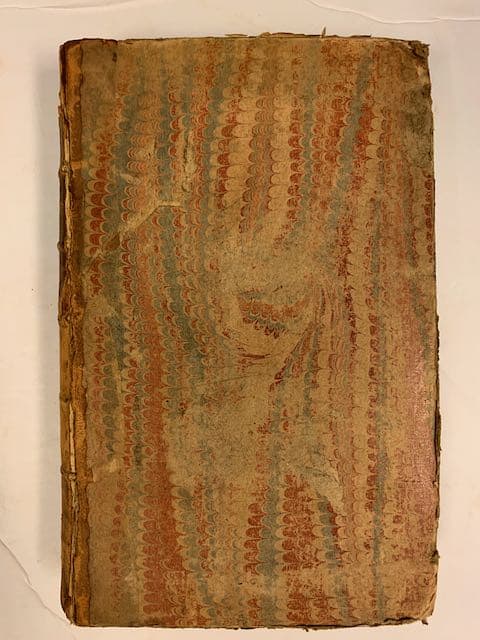
A quick physical inspection of the book (as seen in the photos below) shows that it is bound in it original 18th century marbled boards. Unfortunately, the spine is rather dry and worn, but to its credit, the pages are what we call “uncut” – which is a heartwarming word to rare book dealers and collectors who appreciate original condition.
A quick review of the auction databases on sites such as RareBookHub, reveal a rather depressing state of affairs. A copy of this First English edition sold for $23.50 in 2014 at auction. I have to retype that for emphasis as it is quite unbelievable to type even. $23.50!! Can you imagine an an interesting 18th century work being sold for the price of a few lattes at Starbucks? It shows that not everything old is gold.
The prices of retail copies is a bit more reassuring. On sites like ViaLibri, one can find ranges for the book (or at least similar editions) from about $200-900, depending on the exact edition, condition etc. With that said, there appears to be several copies circulating in commerce, and it is getting harder and harder to sell books of which several copies can be found online at the touch of a few buttons.
This particular copy has some redeeming aspects which I believe raise the value and its desirability – and as a rare book dealer, it is my passion and job to discover and highlight them. First, it has a lovely late 18th century bookplate of CHAINED MONKEYS. That is enough charm to win over my heart. A quick Wikipedia search and wee can se that it is the ex-libris of St Andrew St John, 14th Baron St John of Bletso PC FRS (22 August 1759 – 15 October 1817), an English politician who sat in the British House of Commons from 1780 until 1806 when he inherited a peerage. So, this copy of a influential work belonged to a politician during the year that America wrote her Constitution in 1783. Very cool indeed, but generally even that provenance is not sufficient in the market today to substantially raise the value of the copy – albeit, we are building an interesting story around the book.
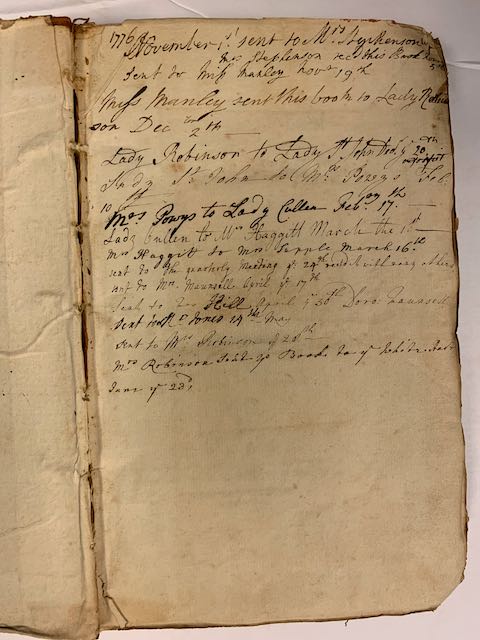
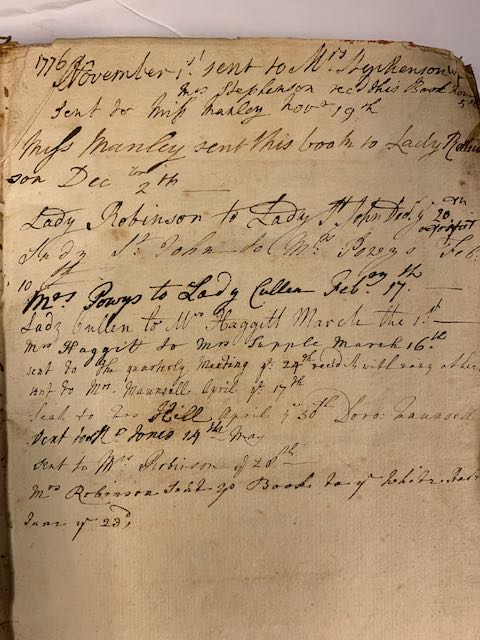
However, it gets better. When I read through the inscriptions in ink on the following page, they contain a very unusual and remarkable record: the book appears to have been passed AMONG WOMEN READERS and women readers alone. It contains such jottings in an old hand as “1776 Mrs. Stephenson received this Book Nov 5 || Miss Manley sent this book to Lady Robinson” The list continues for about 15 lines as the book was clearly circulated among the 18th century aristocratic women, who perhaps were keenly interested in Constitutional law given the regular news of the increasingly tumultuous state of affairs in America. The list of names requires additional investigation, but I have not seen a similar list in any book that I can recall handling.
So, overall despite being a relatively common work in commerce, and well represented in various institutions in its many editions, this particular copy is very interesting and unusual. Its boards are a bit dry and the spine could use some restoration, but generally I would say this is a work that I would be able to price in the $500 range and find some institutional interest from a special collections that focuses on women studies or more generally a law library.
If you have any rare books or manuscripts and would like a free evaluation, don’t hesitate to send photos buy email to webuyrarebooks@gmail.com or by text to 646-4691851.