August 22, 2010
A Law Book described as “as so exceeding[ly] rare, — the pride and the joy, the infinite good fortune and raritas raritarum of libraries of law-books”
The Book:
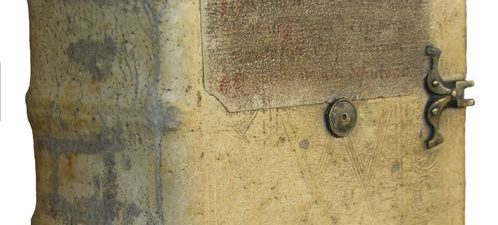
[Richard Bellewe]; [Nicholas Statham]; [Anthony Fitzherbert[; Robert Brooke, Sir]. Les ans du roy Richard le Second : collect’ ensembl’ hors de les abridgments de Statham, Fitzherbert et Brooke. London : Imprinted by Robert Robertson, dwelling in Fewter lane neere Holborne, [1585]. [8], 326 , [6] p.; In Law French. Title within ornamental border. TEXT COMPLETE, though lacking corrigenda leaf, albeit there were up to three impressions of this 1585 ed. without priority and very few copies appear to possess this leaf (if it was issued in all). Full reports of cases for the reign of Richard II were never printed. This collection consists of all cases and scattered notes found in print in reports and abridgements. Some worming present in blank gutters of quire M to end, Contemporary English calf, centers with oval blind-stamp flanked by initials “T.C.” Marvin, J.G. Legal bibliography, p. 110. ; STC 1848a; Beale R478. [$4500]
Provenance:
Thomas Carleton, of whom there are few biographical details, but this is likely the Thomas Carleton, Upper Warden, that appear in a famous 1632 painting in the Painter’s Hall in Little Trinity Lane, which has been studied extensively for its connections and revelations related to the mysterious Chandos Portrait of Shakespeare; Also Bookplate of Hugh Cecil Lowther, fifth Earl of Lonsdale. (see bigraphical info below)
Background:
This Year Book of Richard II, compiled in 1585, has been described by 19th century legal bibliophiles as “as so exceedingly rare, — the pride and the joy, the infinite good fortune and raritas raritarum of libraries of law-books.” The main reason that it was so sought after is that it filled a missing gap in a continuous run of Year Books that every lawyer required or wanted in his library. Additionally, modern law owes a great debt to the later part of the 14th century, during the reign of Richard II, since many of the forms of actions of modern times emanated from this period. [Ref: Wallace, J.W. The reporters: arranged and characterized with incidental remarks, Soule and Bugbee, 1882 .]
Despite the appearance of printed Year Books that included cases of every reign from Edward I to Henry VIII, the very important Year Book of Richard II was lost or omitted. “Why this period was selected for oblivion, history makes no attempt to unravel. There was no dearth of litigation, in this most troubled of reigns, as the huge records of the various terms bear witness. Nor is there even now any great scarcity of manuscripts. Why a system of law built upon history stepped time after time, day after day almost, indifferently across a chasm in which lay great masses of decided cases is beyond comprehension. To this riddle there is no answer.” [Ref: Deiser, G.F. Year books of Richard II: 12 Richard II, A.D. 1388-1389 . Ames Foundation Harvard University Press, 1914]
The Author, Richard Bellewe:
“Richard Bellewe, the author of this work, very little is known beyond the fact that he was a member of an Irish family, and was admitted into the Society of Lincoln’s Inn, 5th June, 1575; there is however no entry of his call to the bar by that society. That Bellewe was a diligent student is evidenced by his collection of Brooke’s ” New Cafes,” temp. Henry VIII., and this volume, which has been designated the Year-book of Richard II. …The numerous inquiries for ” Bellewe’s Cases,” the rarity of the book, and the exorbitant price which copies have realized, led us to believe that a reprint would be acceptable to members of the legal profession and to librarians who desire to possess a complete and perfect series of English Law Reports. (Ref:http://books.google.com/books?id=wg89AAAAIAAJ&pg=PA823&dq=the+rarity+of+the+book,+and+the+exorbitant+price&hl=en&ei=59JdTLCPFoO78gbh67y1DQ&sa=X&oi=book_result&ct=result&resnum=2&ved=0CDwQ6AEwAQ#v=onepage&q=the%20rarity%20of%20the%20book%2C%20and%20the%20exorbitant%20price&f=false]
Hugh Cecil Lowther, fifth Earl of Lonsdale:
“Bookplate of Hugh Cecil Lowther, fifth Earl of Lonsdale. After his father’s death Hugh became one of the richest men in England, with estates which included the Whitehaven collieries, and this enabled him to lead an ostentatious lifestyle, employing yellow-liveried footmen and a special train for his household. He also used his wealth to pursue his various sporting passions, including hunting, boxing (he became the first president of the National Sporting Club), horse-racing (as the first president of the International Horse Show at Olympia), and cars (being the first president of the AA). His flamboyant style also led him into associations with famous actresses, such as Lillie Langtry and Violet Cameron, who bore him a daughter after he took her opera company to New York; to an Arctic expedition, during which he collected a huge number of Inuit artefacts which he donated to the British Museum; and to entertaining European royalty, including the Kaiser, on his estates.” [Ref: http://www.joh.cam.ac.uk/library/special_collections/early_books/pix/provenance/lonsdale/lonsdale.htm]