January 2, 2012

STUNNING 17th CENTURY ENGLISH RED GOATSKIN BINDING


PRINTED 1657: THE RARE Grand Cabinet-Counsels Unlocked

The Book:

[Marguerite, Queen consort of Henry IV King of France] The grand cabinet-counsels unlocked. Or The most faithful transaction of the court-affairs, and growth and continuation of the civil wars in France, betwixt the Huguenots and the papists, during the raign of Charls the Last, Henry the Third, and Henry the Fourth, commonly called Henry the Great. London : Printed by R.H., 1657. 4 p. l., 229 p. ; 16 cm. Very attractive full gilt contemporary red goatskin binding with acorns and numerous other decorative elements. Light worming in the upper left of last few leaves. Provenance: Grinke & Rogers, Cat 3, Item 255 $192 (c. 1974) The Rare English translation by the prolific author Robert Codrington (1602-1665) of the scandalous Memorials of Margaret de Valois. Besides court gossip, it is an important historical work at a critical juncture in the French Wars of Religion. Marguerite was married (August, 1572) at age twenty to her cousin, the young Huguenot King of Navarre, also of the same age. In these Memoirs, the ceremony is described along with her hopes that it will usher in a reign of peace and toleration. Sadly their marriage, the pairing of a Protestant to a Catholic, witnessed the St. Bartholomew’s Day massacre a mere six days later. [SOLD]

posted in: Rare Books

October 10, 2011

THE FIRST STUDY OF EUROPEAN CABINETS OF CURIOSITIES

EXTREMELY RARE: ‘the single most valuable contribution to Wunderkammer studies’

PRINTED 1716: WITH 30 PLATES

EAST INDIAN BOTANY, UNICORNS & SERPENTS, FOSSILS & COINS


The Book:

Michael Bernhard VALENTINI; Joannes Conradus Becker. Historia simplicium reformata, sub Musei Muscorum . Francofurti ad Moenum : Ex Officina Zunneriana, apud Johannem Adamum Jungium, 1716. COMPLETE. [26], 664, [16] p., illustrated with 30 leaves of plates (5 folded) : ill. ; FOLIO, A TALL COPY. 365 x 220 mm. Contemporary English paneled Calf and Gilt with slight bumping to head and foot, and wear to head, some toning, but overall a handsome complete copy. First Edition in Latin. Nissen BBI 2036; Pritzel 328. [SOLD]

Michael Bernhard Valentini (1657 – 1729) was a German doctor and a collector. He had an important Cabinet of curiosities and was the author of Museorum Museum, the first study of collections in Europe. The work for sale here is the first Latin translation by Johann Conrad Becker and edited by Christoph Vern. Valentini (the author’s son) under the title Historia simplicium reformata. It covers plants, animals, minerals and metals and their commercial and medical uses, rocks and minerals, fossils, East Indian and tropical plants, shells, unicorns and monstrosities, coffee, tobacco, tea, cacaa, vanilla, serpents, and even coins.

The Museum Museorum’ is ‘the single most valuable contribution to Wunderkammer studies’. It records and reprints many European collection that are otherwise unobtainable now through any other source. It also contains one of the earliest and most important treatises devoted to cinnamon: Johann Georg Dexbach’ Disput. medica inaug. de Casia Cinnamomea et Malabathro.

posted in: Rare Books

October 10, 2011

Important Bloomsbury Group Provenance

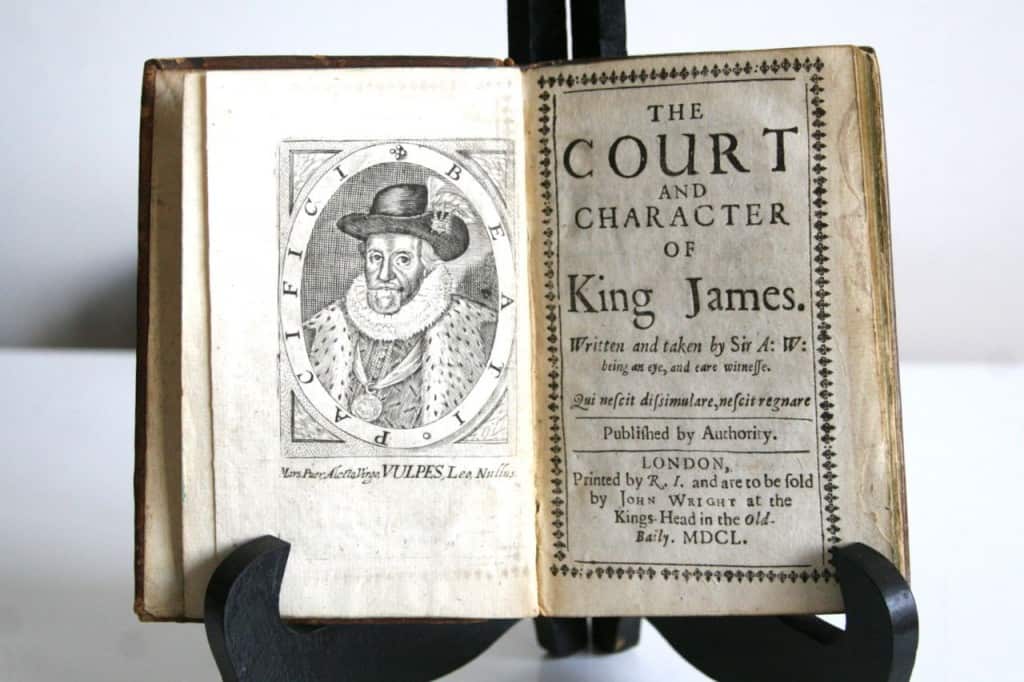
PRINTED 1650. The Strachey – Senhouse Copy of the Work that hinted that King James was a Homosexual

The copy bequeathed by Lytton Strachey to his last lover Roger Senhouse

The Book:

WELDON, Sir Anthony. The Court and Character of King James. Written and taken by Sir A: W: Being and Ear and Eare Witness. London: Printed by R.I. and are to be Sold by John Wright, 1650. small 8vo., iv, 197 p. 14 cm. The small book plate of Strachey by Dora Carrington is a lovely piece of sought-after Bloomsbury history, which surfaces in volumes (such as this one) as Strachey was a keen collector of antiquarian books. Binding: 17th century ruled English calf, some chaffing to one board as depicted, textblock largely separated, wear to spine as depicted, small marginal loss to t.p., some light foxing, but internally an attractive copy. Provenance: Lytton Strachey (1880-1932) British biographer and essayist (bookplate; bequeathed to) — Roger Senhouse (1899-1970), partner in publishing firm of Secker and Warburg (bookplate) and sold at the sale of the Strachey Library, Property of Roger Senhouse, Sotheby’s London, 18 October 1971, lot 826. Wing W1273.  [SOLD]

“Roger Henry Pocklington Senhouse (1899 – 1970) was an English publisher and translator, and a member of the Bloomsbury Group of writers, intellectuals, and artists. The private letters of openly gay writer Lytton Strachey reveal that Roger Senhouse was his last lover, with whom he had a secretly sado-masochistic relationship in the early 1930s.” (Wikipedia)

This scandalous work concerning the King, his ministers and favorites, supposedly by Sir Anthony Weldon, is the primary source of the allegation that James was a homosexual. While his sexuality is subject to scholarly debate, James clearly preferred the company of handsome young men.

It may be noted that Strachey-Senhouse copies are very sought after with few examples that surface in recent auction record. By comparison, the rather worn Strachey – Senhouse – Berland copy of Shelley’s Adonais sold at Christie’s New York, Oct 9, 2001, lot 325, $2,800

posted in: Rare Books

October 10, 2011

VERY RARE 1618 COPY OF JOHN STOW’S CHRONICLE

STOW’S CHRONICLE WAS ONE OF THE MOST IMPORTANT ELIZABETHAN SOURCE BOOKS

BURNING OF WITCHES,
WILLIAM SHAKESPEARE,
DISCOVERY AND COLONIZATION OF VIRGINIA

The Book:

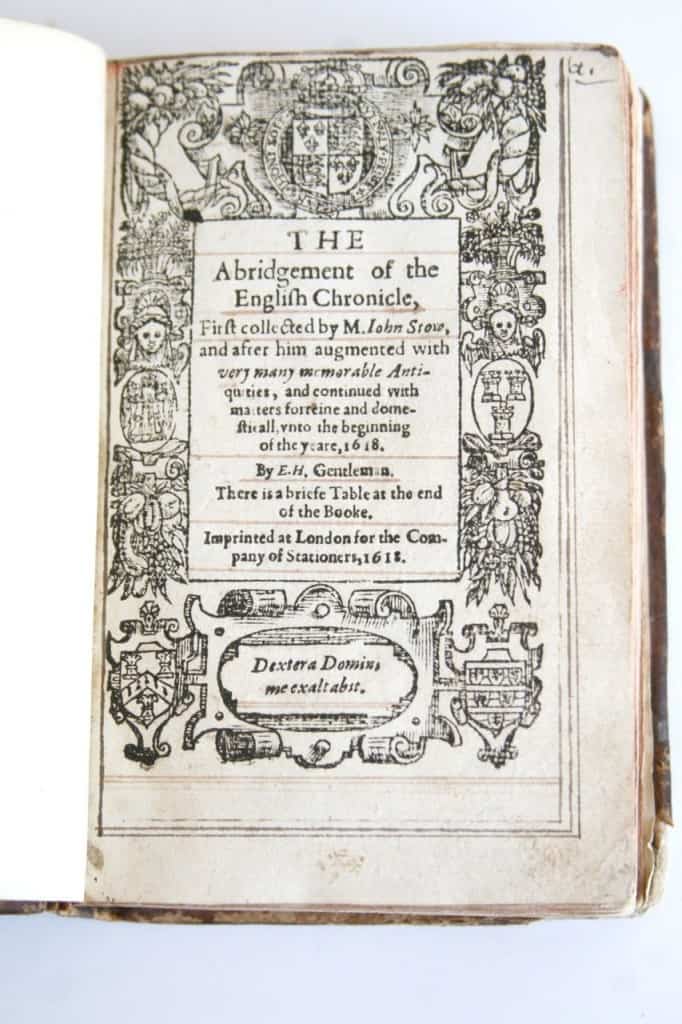
John Stow; (edited and continued by) Edmund Howes . The abridgement of the English chronicle : first collected by M. John Stow, and after him augmented with very many memorable antiquities, and continued with matters forreine and domesticall, vnto the beginning of the yeare, 1618. London : [By Edward Allde and Nicholas Okes], 1618. COMPLETE. [11 of 12, lacking only blank A8 as in Macclesfield copy], 568 [i.e. 564 (due to page numeration error), 16] p. ; 8vo, 16cm., Page numeration errors (but no missing leaves); p. 465-466 and 487-488 are mis-numbered. Printers’ names, not explicit on t.p., taken from STC. Early calf worn as depicted, boards partially separated, some toning, later endpapers, occasional worming, ample title page margins with hand drawn borders, a page of the table re-margined with no loss, interesting marginalia including a 4 line poem on the lower margin of 242, presumably referring to King Henry VIII and employing similar phrasing to Macbeth with “hath no end”. Occasional signatures of early owners on 2 leaves , later provenance of Charles Frederick Tootal. A 17th century hand rightfully notes “thus far Stow” on p. 436, indicating the continuation of the Chronicle by Howes. VERY RARE. All of Stow’s and Howe’s early Chronicles are rare; they were very popular and often read to shreds, accounting for the poor condition of surviving copies. THE ABPC lists only two copies of the 1618 at auction in 30 years; the last, the Macclesfield copy described as “Lacking blank A8; blank A1 becoming detached; a few small tears with marginal loss” and a second copy in poorer shape than the present listed as “rebacked, rubbed – Dampstained throughout; some foxing & soiling.” [SOLD]

This is Howe’s continuation of Stow’s famous Elizabethan Chronicle. It was issued in several editions, starting in 1610, each adding to the previous to keep it up-to-date. Howe evidently labored five years on its preparation, compiling important source material firsthand including a list of all the principle fairs held throughout England and Wales (appended). This edition is of particular interest to Shakespeare scholars as it recounts the burning of the famous Globe Theatre in 1613, noted for its performances by Shakespeare and his associates. Additionally, it provides important Shakespearean literary references and background information. For instance, in the Winter’s Tale, where we hear of “Gloves as sweet as damask roses,” Howes offers some insightful historical context to perfumed gloves. He states (spelling partly altered) that the English could not ” make any costly wash or perfume, until about the fourteenth or fifteenth of the Queen [Elizabeth] the right honourable Earle of Oxford came from Italy, and brought with him gloves, sweet bagges, a perfumed leather jerkin, and other pleasant things: and that year the Queen had a pair of perfumed gloves trimmed with foure tuftes, or roses, of cullered silke. The queene took such pleasure in those gloves, that she was pictured with those gloves upon her hands: and for many years after it was called the Earle of Oxford’s perfume.

The rest of the work is likewise filled with fascinating historical tidbits from tales of Burnt Witches (p. 172), to when Queen Elizabeth I granted Sir Walter Raleigh a charter for the colonization of the area of North America known as Virginia (p. 512)


posted in: Rare Books

October 10, 2011

LARGE 16th CENTURY MANUSCRIPT ON VELLUM

ANTIPHONARY / CHOIR BOOK


MANUSCRIPT ON VELLUM. [s.l., s.d c. 16th century Spain]. Antiphonary and Choir book for the Common of Saints (Commune Sanctorum) supplemented by a certain number of votive Masses. LARGE FOLIO., approx. 51 cm x 35. (iPhone in photo for size comparison) Reversed calf over wood boards, faint impressions of metal fixtures. Approx 160 pages, some leaves apparently lost, some repairs, darkening to vellum as always. An impressive volume, and certainly a conversation piece. [SOLD]


posted in: Rare Books