February 8, 2013

The Rare Book Buyer

Many people have old and rare books in their homes that have been passed down in the family.  They might include a well-loved and worn edition of Dickens that may be worth only a few dollars or an unnoticed early colonial printing that could be worth thousands. Whether to raise money or simply because they can no longer be properly cared for, books gets sold. Nevertheless, selling a library or inherited book can be a very emotional process. Books contain not just the voice of their authors but reflect the person who bought them and can often bridge generations in a family. These short stories are meant to chronicle some of those connections and collections.


SELLER: Chris

LOCATION: Wallingford, Connecticut

WHO COLLECTED THE BOOKS:

The books, stacked in neat piles on the basement floor, were part of
the collection formed by Eugene Silver Barry,
Chris’s maternal grandfather.  Eugene S. Barry left school at twelve
and by his late twenties opened a leather tannery. He befriended a
bookseller in Boston, who in exchange for leather, offered rare books
and expert advice. Clearly, a love of books was an inherited trait as
his own father, Eugene Barry, Sr., was a published poet and an
original donor and trustee of the Lynn Woods Reservation, one of the
largest largest municipal parks in the United States. A humble volume
of his 1904 poetry, inscribed to his wife, sat lightly bruised and
infrequently dusted on the shelf.

BOOKS BEING SOLD:

Many of the books being sold concern voyages. As a leather tanner, Chris’s
Grandfather had a natural interest in the fur trade and exploration
books concerning the NorthWest Passage, the potentially highly
lucrative trade route between the Atlantic and Pacific oceans that
captured the imagination of generations of explorers. Collecting
exploration books was a shrewd investment. Mankind always has
yearned to uncover the mysteries of new lands and the fascination
has not escaped the attention of collectors. Fine copies
of important voyage and exploration books have become expensive.

BOOKS NOT BEING SOLD:

There is a nice ten volume 1912 set in blue cloth of The Photographic
History of the Civil War. That will stay in the family.
Chris’s relative, Sergeant Joseph R. Balsley of the 142nd Pennsylvania
Infantry, fought at Gettysburg and the set contains
thousands of Civil War photographs including those of Matthew Brady.
Chris proudly showed me his relative’s original battle sword.

Another book of sentimental value that will remain on the shelf is a
copy of Kipling’s Just So Stories. Chris’s Grandfather read it to him
as a child, but today he hesitates to read it to his own
grandchildren. The story of how the elephant got his trunk seems
dated and less palatable today when the paragraphs end with
“they beat him.”

A BOOK WORTH HIGHLIGHTING:

An attractive and sought-after copy of John Marshall’s The Life of
George Washington was one that grabbed my attention. Copies at auction
generally command $1500-2500 or more depending on the condition and issue.
This wonderful six volume set was printed between 1804 and 1807
and unites two great historical figures in American history- Chief
Justice John Marshall, the principal founder of our constitutional
law with George Washington, a founder of our nation. Washington was a
major influence on the young Marshall, and his eloquent biography was
drawn from Washington’s diaries, letters and secret archives. The
accompanying, and often missing, Atlas volume contains maps of
Revolutionary War battlefields. It is the type of patriotic work that
no doubt would have interested the upstanding and civic minded Barry
family.

REASON FOR SELLING:

There is no room in the house anymore and the books have been moved
between homes several times, with the occasional
nick in a spine or missing volume resulting from the shifts.

PLANS FOR THE MONEY:

The money will be funneled into the upkeep and care for a family property
in Maine. The property was originally bought by Eugene Barry, Sr. in 1988.
As Chris explained, he met a women (Lucy Wyman) from Sebec Village, at the
eastern end of the lake, at a church social after the men had rowed 12 miles
just to get there! They married, and the property has been in the family ever since.
Chris is the fourth generation and his grandkids are the sixth. It is a comforting
thought that the books have come full circle and the proceeds will benefit the family
property that was so dear to his Grandfather’s heart.


The books as seen piled on the basement floor in Chris’s home


The First Edition of Marshall’s Life of Washington


The Civil War battle Sword of Sergeant Joseph R. Balsley

posted in: Uncategorized

October 14, 2012

HOW TO VALUE A RARE BOOK

APPRAISING AN 18th CENTURY RARE  BOOK ON CLOCKS AND WATCHES

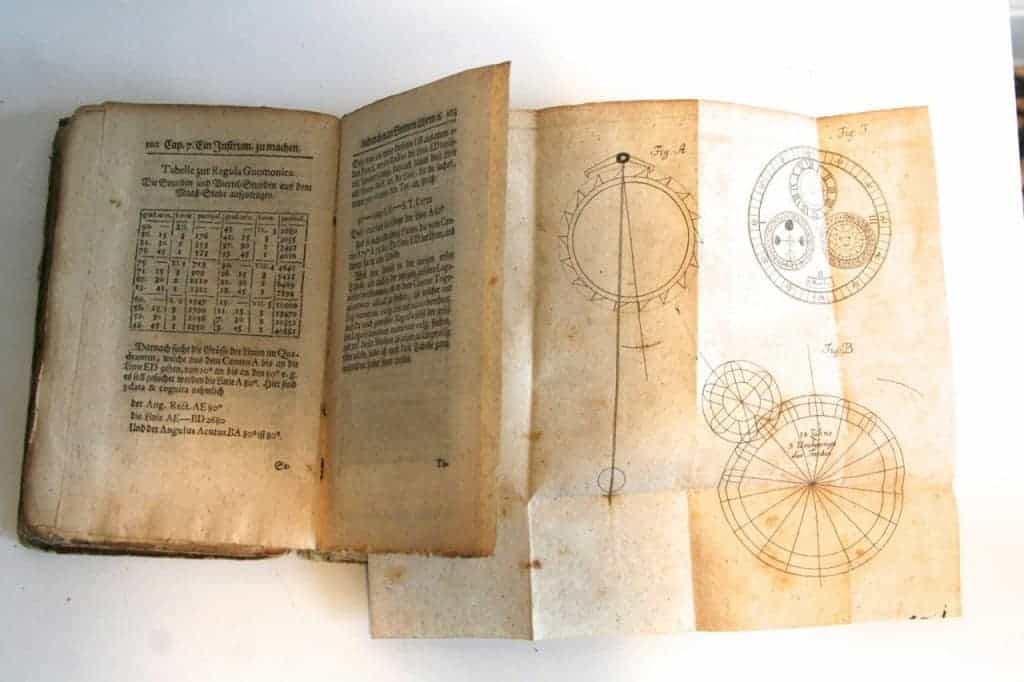
We just received in the mail a very interesting work on watch and clockmaking from 1732:  Johann George Leutmann’s Vollständige Nachricht von den Uhren.  This is a complicated work and typographically intimidating.  It is  printed in black-letter script with only occasional Roman script, a style that remained  common in Germany  until the end of the 18th century.  It is not a book, like a signed limited copy of the Little Prince, for example,  that can more easily be looked up on the internet for a range of prices.  So, I thought it would be instructive, to outline what goes through the mind of a bookseller when appraising a book’s value:


There are several factors one must reasonably consider:


IMPORTANCE: When evaluating an old book, and once it has been identified, it is necessary first to get a sense of its importance.  Some books are rare, but not necessarily important and therefore not very valuable.    The book here is important.   A little research indicates that it is considered to be the  “The first detailed treatise on clocks and watches.” (Baillie, Clocks and Watches, p.147).  Book dealers are often fond of books that can be labeled “the first of this” of the “first of that”, and while they sometimes go to extremes to elevate a particular book’s importance with such descriptive labels for the purpose of marketing, this is truly a breakthrough work in horology.  It is particularly  fascinating, as while some other earlier works had touched upon clock mechanisms, Leutmann delves into the relatively newer area of pocket watches and portable time pieces, with a chapter even on how to tell the age of a watch (albeit that is not much use today if you like a glitzy Rolex or a more subdued vintage Patek Phillipe)


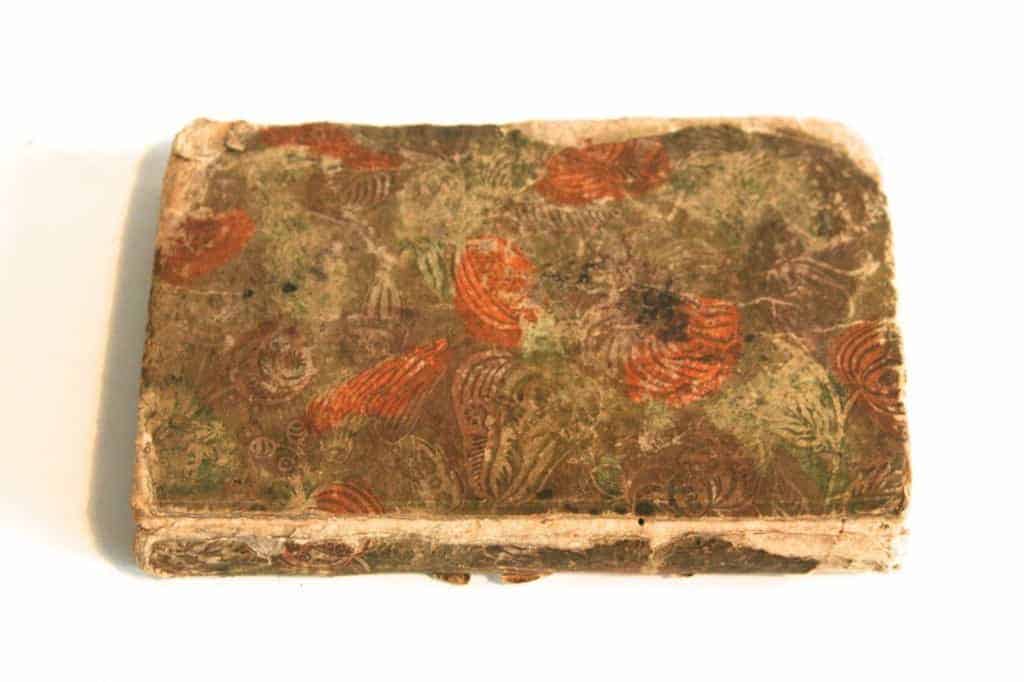
THE BINDING:  The binding of this book is a scarce and collectible binding.  It is a Brocade paper binding that is almost certainly contemporary with the book (i.e.  from the 1730s).  The paper was originally printed in bright colors, with an abundance of  decorative leaves and flowers.  It is now worn, and like many things that suffer the ravages of time, only displays a glimpse of its former beauty.  Still, it is a quite fascinating as an example of innovative and inexpensive 18th century European bookbinding.


RARITY: The book is not a first edition, as it was originally issued in 1718.   Still, it is a work that very rarely appears at auction in any edition.  I have only been able, in fact, to trace two copies at auction in the last thirty years.  There are several subscription databases to check auction results such as the ABPC, AmericanaExchange, and in the case of German books, the JAHRBUCH der Auktionspreise für Bücher.   A quick and free option to ascertain rarity is to look at Worldcat.org.   This is a solid, albeit not entirely comprehensive, database of holdings of  books in Institutional Libraries (how many libraries have copies of a particular book).   Worldcat has its flaws, such as duplicate listings, incorrect listings of actual books vs. microfilmed copies etc.  Still, it is very helpful, and certainly one can also get the collation (page count) and cataloger’s notes of many rare books.  Through Worldcat, I was able to trace only 9 other copies of this 1732 edition- so it is quite rare.


PROVENANCE: It is essential when evaluating a book, to look for signs of previous ownership, bookplates, annotations, inscriptions etc. and to assess their importance. In this book, we do have some ownership signatures in a fairly illegible hand, but which read “Ex Libris W.W. Eckark”    Now, if that was an important and identifiable watch or clockmaker, that would certainly raise the value of the book.  Unfortunately, there is scant biographical information on who that is and as such it does not contribute much to the value.  Additionally, there are some mid-18th century notes to the inside of the front cover (paste-down) of the book.  These notes however just reference and re-state part of the text and do not appear to be significant.


COMPLETENESS:  The work should contain 2 parts in 1 volume with 2 engraved frontispieces, 30 engraved plates and 16 tables (mainly folding, or double-page). One must carefully check and count all pages.  While all the text pages are present as well as the 2 engraved frontispieces, this copy only possesses 18 of the 46 plates and tables and therefore must be considered severely defective.


VALUE: While the book is extremely important in the history of horology and is bound in an interesting 18th century binding,  it is incomplete.   It is a unfortunate fact that collectors and dealers want complete books even if that means passing over otherwise interesting and rare works.   Condition and completeness are extremely important when it comes to assessing the monetary value of a book.  Were this a complete example, it would have a value in the range of $1500-2000.   Sadly, with so many plates missing, it is just an antiquarian curiosity to those interested in watchmaking or bookbinding, but something not likely worth more than $300.

posted in: RARE BOOK APPRAISAL

September 17, 2012

WHAT IS MY OLD BIBLE WORTH?

One of the most common questions any rare book dealer receives is  “What is my Old Bible Worth?”

With notable exceptions, most Bibles printed after 1800 in America and after 1700 in Europe are actually not worth very much money.  That is simply a consequence of the fact that so many Bibles were printed as well as the fact that many were treated as important family heirlooms and have therefore survived the ravages of time.

With that said, there are exceptions to the rule for Bibles with unique appeal or characteristics.    For instance,  there are historically interesting Bibles such as the 1858 “Pony Express Bible” that is a coveted artifact of the Old West or the Harper’s Illuminated and New Pictorial Bible (1843- 1846), which was the  most extensively illustrated American book up until its time.  There are also feats of the printer’s art such as the 1800 Giant Macklin Bible Seven-Volume Bible, which is considered among the most impressive Bibles ever printed.

If you have any questions about a Bible you may have (especially any printed before 1800), feel free to send photos to webuyrarebooks@gmail.com. We are happy to offer a free evaluation.

I thought it would be instructive to look at and appraise, in a step-by-step fashion, a Bible that was recently sent to us and which is shown in the photos below.

IDENTIFICATION:

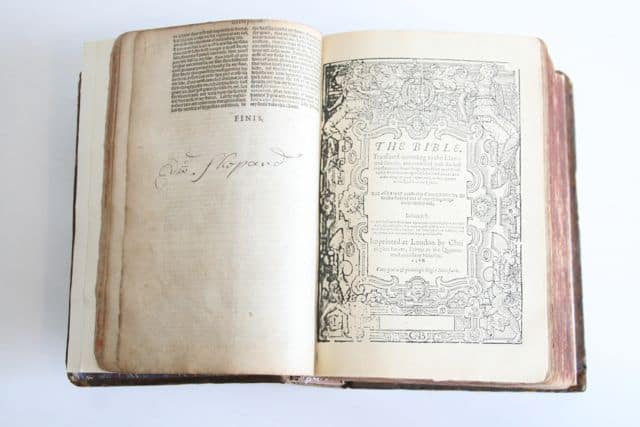
The book we received was a 1580 copy of the Geneva Bible.  The Geneva Bible is one of the most significant translations of the Bible into English. It was first printed in 1560, a full 51 years before the King James Bible.  It is often referred to as the “Breeches Bible”, because of its translation of Genesis 3:7 (“they sewed figge tree leaves together, and made themselves breeches”).  The Geneva Bible  is  also considered to be the “Bible of the Protestant Reformation” and was naturally the Bible the Puritans held so dear as they stepped off the Mayflower.   The edition here from 1580 is an early edition and increasingly scarce in commerce.

As is often the case with the early Bibles, they are a complicated patchwork of various editions and parts.  This one consists of the following:

[I] The Booke of Common prayer and administration of the Sacraments : and other rites and ceremonies in the Church of England.Imprinted at London : By Christopher Barker …, 1580.  BOUND WITH.. The  Holy Byble.  Publisher: Imprinted at London : By Christopher Barker, printer to the Queenes Maiestie, 1580.  The Newe Testament Of Ovr Lord Iesus Christ Publisher: London: Imprinted by Christopher Barker, 1580.  BOUND WITH… Tvvo right profitable and fruitfull concordances : or large and ample tables alphabeticall. The first containing the interpretation of the Hebrue, Caldean, Greeke, and Latine wordes and names scateringly dispersed throughout the whole Bible: and the second comprehending all such principal vvordes and matters, as concerne the sense and meaning of the Scriptures. The further contents and vse of both the which tables, (for breuitie sake) is expressed more at large in the preface to the reader. Collected by R.F.H.Publisher: Imprinted at London : by Christopher Barker, printer to the Queenes Maiestie. Cum priuilegio Regiæ Maiestatis, [1580] BOUND WITH… Thomas Sternhold; John Hopkins; William Whittingham.  The whole boke of psalmes. Publisher: At London : Printed by Iohn Daye, dwelling ouer Aldersgate, 1580.

COMPLETENESS AND CONDITION:

Perhaps the first thing to consider in an appraisal, after the identification of the Bible and an assessment of its historical importance, is its completeness. Sadly, in the case of this particular Bible, it is NOT complete.  The first part bound, the Booke of Common Prayer,  is just a fragment.  The title page of the Old Testament is missing and has been replaced by a modern facsimile.  Finally, the Book is Psalms is also severely incomplete.   This certainly affects the value significantly as there is a very wide price disparity between complete copies and incomplete ones (especially when important pages are missing such as a title page).  As to the condition, when it comes to early bibles, as they were heavily used and often printed on inexpensive paper stock, one must be somewhat forgiving of the general browning and occasional stains found in the present example.

THE BINDING:

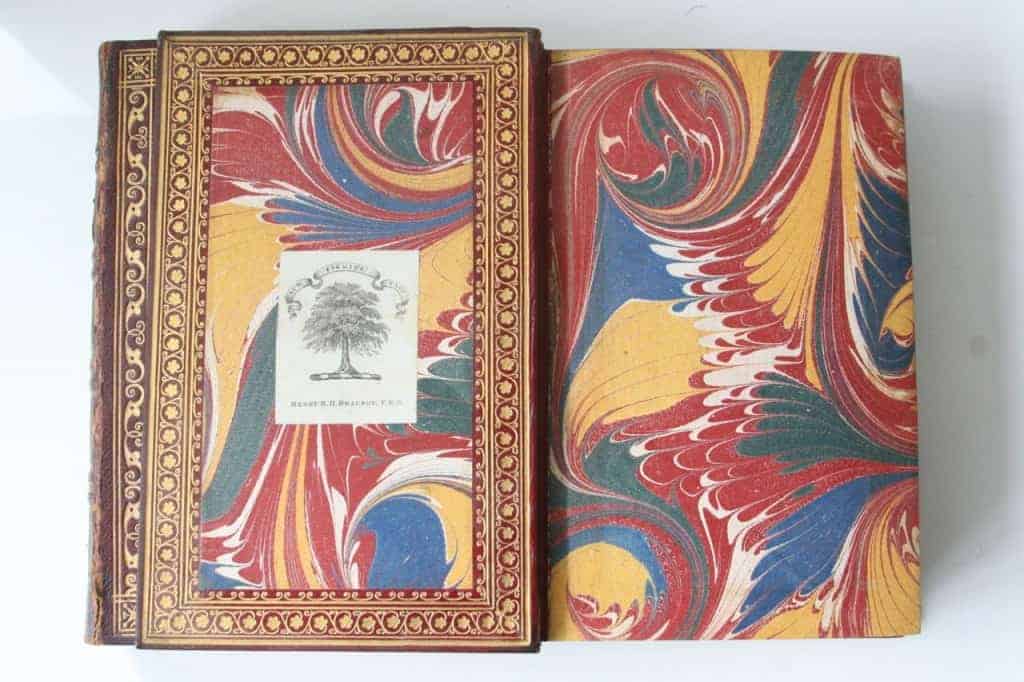
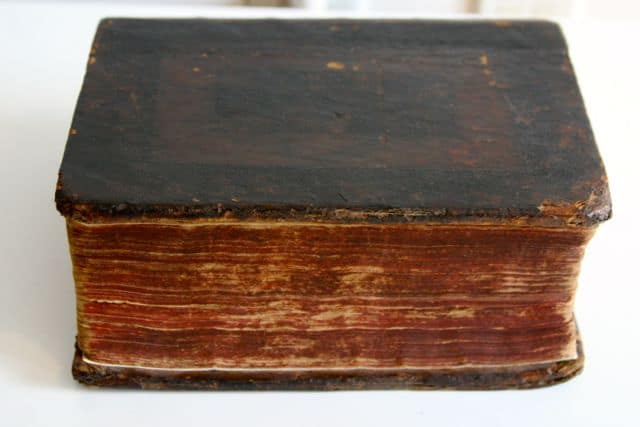
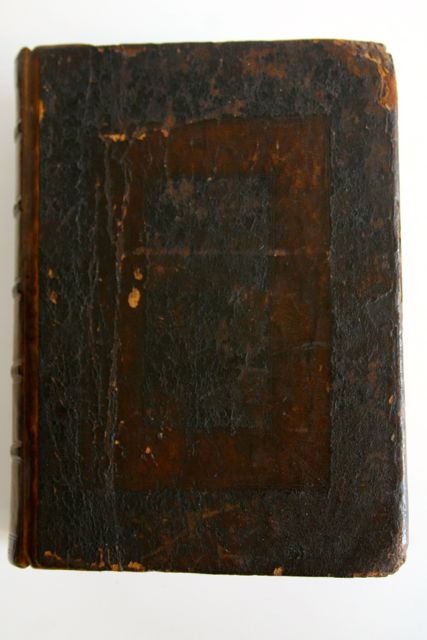
A full original binding (i.e.’ contemporary’ or period) is certainly the most desirable.   This Bible retains enough of the original English paneled calf (likely 17th century) to at least have that wonderful immediate impression of historical authenticity.  With that said, it has been re-backed, i.e. the spine is a period-style, but modern spine.   The paste-downs and the flyleaves are marbled paper and a bit anachronistic for a 16th century Bible.

THE PROVENANCE (PREVIOUS OWNERS):

Occasionally it is possible to find signatures or genealogical records that can tie a specific Bible with an important previous owner or prominent family. It would be lovely to find a copy of a Bible owned by Byron, for example.  In this example, we only have one early owner’s signature to the verso of the last leaf of the Book of Common Prayer: an “Edw. Shopard (likely Shepard) ” in a handsome 17th century calligraphic script.  While there is an early Puritan settler by that name, it is too common a name of the period to ascribe to any particular individual with any confidence.  So, insofar as we are concerned with this Bible, there is little provenance that can add to its value.

VALUE:

We might next turn to internet to look for similar examples.  With Bibles, this can be a treacherous starting point.  Often on the internet, it is possible to find similar Bibles quoted at very high sums.  These are often marketed to buyers that are not sophisticated book collectors, but perhaps just  people who want to own a nice old Bible and are not familiar with the market.   As an enthusiast of early printing, I must say that while I think early Bibles are grossly undervalued when compared to other collectibles, it is still possible to buy them at numerous regular book auctions and often at  surprisingly modest prices. Therefore, when looking for an accurate appraisal, most serious dealers turn to the auction records as a benchmark.

In the American Book Prices Database, it is easy to find a similar example of this Bible that sold in 2010 for approx. $475.  While the flaws are not identical, they are comparable. One should note that the Bible at auction likely possessed a more attractive binding than the present copy as it is described as having “blind-tooled calf with metal fittings”, which can be very handsome.

The auction record for a similar copy:
Bible in English – [New Testament Geneva-Tomson].  L: Christopher Barker, 1580 – Bound with The Sternhold Whole Booke of Psalmes, 1580. – 8vo, – contemp blind-tooled calf with metal fittings – worming to lower cover, rebacked, upper joint split – Bible lacking 1st title & all before E2; a few short tears with loss; 1 leaf def. Psalmes lacking c.25 leaves & with soiling & dampstaining – Bonhams, Oct 12, 2010, lot 206, £300 ($477) – STC 2129; Herbert 164

It is therefore not unreasonable to conclude that the present Bible at auction would command something on the order of $400.   That seems like a rather paltry some for such an interesting and early Bible.   I must agree that indeed it is!   If the general public were more appreciative of the wonder of holding a 16th century Bible in one’s hands, perhaps prices would be higher and booksellers would be happier 😉


posted in: Rare Books

April 7, 2012

The First Major Account of Discoveries and Invention in the NEW WORLD

PRINTED 1646:  2 VOLS in 1:   “The history of many memorable things lost”

The Book:

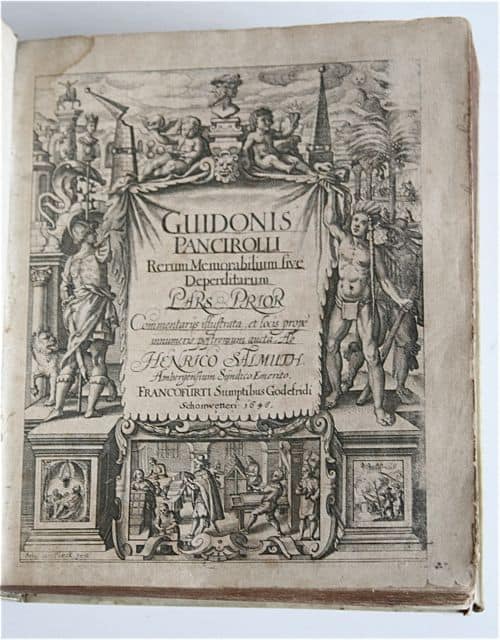
[SCIENTIFIC INVENTION] [THE NEW WORLD] [EARLY ENCYCLOPEDIA] Pancirolli, Guido ;  Salmuth, Heinrich];  Guidonis Pancirolli rerum memorabilium sive deperditarum pars prior[-liber secundus] : commentarijs illustrata, et locis prope innumeris postremum aucta, Publisher: Francofurti : sumptibus Godefridi Schonwetteri, 1646.   The title-page is engraved.Title of v.2 reads: Nova reperta sive rerum memorabilium recens inventarum, & veteribus plane incognitarum … liber secundus. The second part completed by Heinrich Salmuth. 2 vols in 1.  COMPLETE. 2 vols in 1.  Small 4to, 21 cm.   Contemporary vellum with yapp edges, some chaffing to inner front board, small hoel to blank flyleaf, minor upper inner marginal stain to first few leaves, t.p. lightly browned, some light browning throughout,  last few leaves with some wear to l.r. margins.  Overall an attractive copy that contains the often missing second volume on the New World. [SOLD]

Guido Panciroli of Reggio, was a professor of law at Padua and a scholar with immense antiquarian interests.  This treatise, which was translated into Latin with copious annotations by Henry Salmuth, is considered the second most important book on “inventions” and the first to really touch upon the new world in any detail.  It follows in the footsteps of  the Italian humanist Polydore Vergil (1470-1555) whose popular and oft-reprinted work, On Discovery (De inventoribus rerum, 1499), was the first comprehensive account of discoveries and inventions written since antiquity.  Here Panciroli and Salmuth treat many diverse subjects, including the New World  (“De Novo Orbe”- Panciroli was in fact one of the first to use the term new world), alchemy, spectacles, tournaments, clocks, porcelain, falconry, as well as many particulars including  “[Indian] knives made of stone, pictures made of bird feathers, and the famous Benzoar stone- that universal antidote for any poison.


posted in: Rare Books

April 7, 2012

PRINTED 1678: HISTORIOGRAPHY OF TYROL

A UNIQUE EXTRA-ILLUSTRATED COPY WITH 28 MAPS AND CITY VIEWS

The Book:
Brandis, Franz Adam.. Dess tirolischen Adlers immergrünendes Ehren-Kräntzel, oder, Zusammen gezogene Erzehlung jeniger schrifft-würdigsten Geschichten, so sich in den zehen nacheinander gefolgten Herrschungen der fürstlichen Graffschafft Tirol von Noë an, biss auff jetzige Zeit zugetragen.  Gedruckt zu Botzen [Bolzano] : Bey Paul Nicolaus Führer, im Iahr 1678. ||  Second part (with special register & pagination) has half-title: Dess tirolischen Adlers immergrunenden Ehren-Kra?ntzels, anderer Thail : handlent von den fu?rstlichen Stifften Trient vnd Brixen und so dann von dem Ursprung der vier Stande der furstlichen Graffschafft Tirol.|| Allegorical frontispiece and map drawn by author; twelve (12) engraved  plates display varying numbers of coats of arms.  Description: 4to., 20 cm;  [8], 234, [2], 224, [4] p., [14] leaves of plates (2 folded); 28 additional inserted maps and plates   UNIQUE EXTRA- ILLUSTRATED COPY: In additional to the 12 engraved heraldic plates, frontis. and map called for, this copy possesses 28 (TWENTY-EIGHT) fine folding Important Maps and Town Plans, carefully inserted into the relevant text sections, the majority signed in plate by the well known Augsburg Cartographer Gabriel Bodenehr (1664-1758).   18th century Calf, worn, text-block bowed, some toning and foxing.  Provenance: Important Brandenburg  provenance including heraldic ex-libris bookplate with motto “Mein Thun und Leben ist Gott ergeben (“My acts and my life are devoted to God”).  Ref: Graesse I, 519; Allgemeine Deutsche Biographie III, 246.  VERY RARE; An ordinary edition with the 12 heraldic  plates only  appeared only 1 in 30 years of ABPC auction records.  [SOLD]


posted in: Uncategorized