Tag: Italian Incunable

March 24, 2010

HIGHLY IMPORTANT ISLAMIC INFLUENCED VEGETAL BLINDTAMPED BINDING

PRINTED 1489: ONE OF THE EARLIEST ENCYCLOPEDIC TEXTS


The Incunable:

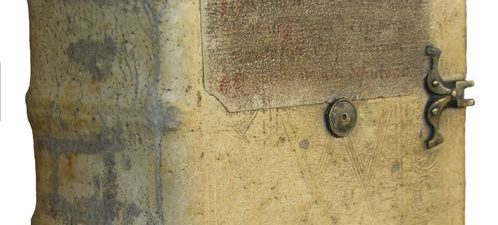
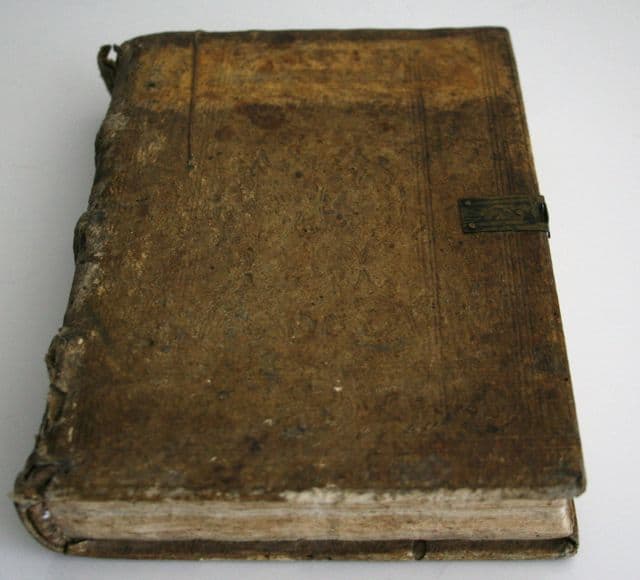
Alexander, of Hales; Giovanni Antonio Beretta; Francesco Girardenghi . Prima pars Alex. de ales. [Summa universae theologiae.] Papie. : Per Joa[n]nemantonium de birretis ac Fra[n]ciscum gyrardenghum., M.cccc.lxxxix. Die. xi. Iulij. Colophon, pt. 1: Per Joa[n]nemantonium de birretis ac Fra[n]ciscum gyrardenghum. Papie. M.cccc.lxxxix.Die. xi. Iulij , 1489),. 22 x 16 cm., small 4to., 223 lvs.,; mimor worming affecting last few leaves., COMPLETE PART I of the SUMMA. Islamic Vegetal tools and Medieval Zoomorphic tooled Blindstamped German Pigskin binding, with Italian-Islamic influence. Light bumping to top of spine, slight peeling to lower right hinge of spine, but overall a VERY GOOD UNRESTORED AND RARE CONTEMPORARY BINDING. Provenance: Private collection for over 50 years (not offered at auction); Price 950 DM c. mid 1950s.

This collected work by Alexander Hales (d. 1245), represents one of the first encyclopedic texts, in part concerned with divine and natural law. The work follows in the tradition of the famous Etymologies of Isidore of Seville (seventh century), and was not doubt written in response the rise of Universities which ignited the passion for such encyclopedic works. Examples of other such encylopedic ‘Summae,’ include various Commentaries of Peter Lombard, the Master of Sentences, as well as works by Ricardus Rufus, St. Thomas, Albertus, Pliny etc.

The Pigskin binding is a Very Rare and Important Example of Islamic-style vegetal patterns on a blind-tooled binding, which drew motifs from “existing traditions of Byzantine culture in the eastern Mediterranean and Sasanian Iran.” Such Islamic style blindstamping preceded the importation of other Gold-tooling techniques from the Islamic world.

One can see parallel stylistic examples in wood of the “beveled style—a symmetrical abstract floral motif” at this link

pav1 pav2

posted in: Rare Books

November 22, 2009

1476: HISTORY OF THE FLORENTINE PEOPLE: THE “FIRST MODERN HISTORY BOOK”

FIRST EDITION, SPLENDID OPENING ILLUMINATION; COPY BELONGING TO LUCIEN BONAPARTE

THE EARLIEST PRINTED ACCOUNT OF THE LIFE OF DANTE

The Book:

BRUNUS ARETINUS, Leonardus (1369-1444). Historiae florentini populi, in Italian. Translated from the Latin by Donatus Acciaiuolus. Venice: Jacobus Rubeus, 12 February 1476. FIRST EDITION. Folio. (320 x 230 mm). Collation: a-k10 kk6 l-p10 q12 r-x10 (a1 blank, a2r translator’s prologue, a2v author’s prologue, a3v text, x10r colophon, x10v blank). 218 leaves (inc. first blank). 41 lines. Type 1:110R; Colophon: FINE Delduodecimo & ultimo libro della historia del Popolo Fiorentino composta da Messer Lionardo aretino in latino:Et tradocta īlingua tosca da Donato Acciaioli a di.xxvii.dagosto:Mcccclxxiii. Impresso a Vinegia perlo diligente huomo Maestro Iacomo de Rossi di natione Gallo:Nellanno del Mcccclxxvi.a di xii.di Febraio:Regnante lo inclyto Principe Messer Piero Mozenico. Opening initial M finely illuminated by a contemporary Florentine artist in gold leaf on blue, pink and green ground with white penwork infill, extensive white-vine decoration on blue, pink and green ground flanking a central painted armorial shield (rubbed). 19th century vellum over boards, gilt turn-ins, front board detached, spine detached. COMPLETE, WIDE-MARGINED AND TALL COPY; dampstaining throughout and stains, two pages with old repairs, colophon leaf mounted. HC1562; BMC V, Proctor 4242; Goff B-1247. PROVENANCE: Lucien Bonaparte, Prince Français, 1st Prince of Canino and Musignano (21 May 1775 – 29 June 1840), born Luciano Buonaparte, the third surviving son of Carlo Buonaparte and his wife Letizia Ramolino. and the younger brother of Joseph and Napoleon Bonaparte; Evidently presented by Guilliame Libri, the notorious 19th century book thief who removed items from many Continental libraries; French, Asa Palmer (1860-1935) U.S. Attorney for Massachusetts, 1906-14.; Maggs Bros Cat. #330; 1914. [$28,000]

“Leonardo Bruni’s most notable work is History of the Florentine People, which has been called the first modern history book. Bruni was the first historian to write about the three period view of history: Antiquity, Middle Age, and Modern, a concept from which the term Middle Age was coined by a contemporary Flavio Biondo. The dates Bruni used to define the periods are not exactly what modern historians use today, but he laid the conceptual groundwork for a tripartite division of history. While it probably was not Bruni’s intention to secularize history, the three period view of history is unquestionably secular and for that Bruni has been called the first modern historian.[1] The foundation of Bruni’s conception can be found with Petrarch who had first written, a generation earlier, about a “Dark Age” covering the period from the time of the fall of Rome extending to the time of Petrarch. Bruni and his fellow humanists believed they had reached the end of the Dark Age and were entering a modern period and thus logically called the intervening period a Middle Age.” [Ref: Wikipedia] Included in the chronicle is the earliest printed account of the life of Dante. The printer, Jacobus Rubeus, was a friend of Nicolas Jenson, the famed typographer, and the type employed here model Jensonian typefaces.

posted in: Rare Books